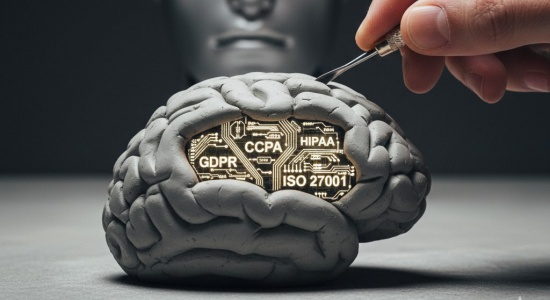
If you ask people inside companies what they really think about artificial intelligence, most will tell you some version of the same thing. They love the idea of it, but the real thing never fits as neatly as the presentations promise. Everyone imagined AI as this universal brain that you just plug into your business and suddenly your workflows become smooth and magical. But when you actually try it, it feels more like hiring a very smart intern who keeps mixing up your internal terms, misunderstands half your documents, and needs constant reminders about how things are done here. And so, little by little, companies are realizing that the real value of AI isn’t in its general intelligence but in how much it can be shaped to fit the specific messiness of their own reality.
The surprise for many teams is that a general AI, even a powerful one, still doesn’t get the small but important details. It knows what an invoice is in theory, but it doesn’t know how your company treats exceptions or why line 7 matters twice as much as line 3. It can write a decent email, but it doesn’t know the tone you use with old clients or why you avoid certain phrases that sound too pushy. These differences may feel small but they build up fast. After a few weeks people start feeling like they spend too much time teaching the tool instead of getting value from it. For more on this, read about consulting companies in remote sensing.
Customization as the Key to Internal Trust
This is where customization starts to change the game. Once an AI system is trained on a company’s own documents and its own way of speaking, something clicks. It stops acting like a guest and starts acting like someone who actually works there. It understands the slang, the acronyms, the weird folder names, the way reports get written, the vibe of internal emails. Suddenly it needs less explanation. It guesses better. It stops making the same mistakes. And employees notice that, almost without them realising, using the tool becomes much easier.
A lot of this has to do with trust. People don’t like using a tool that feels inconsistent or random. When an AI isn’t adapted, you never know if it will say something that doesn’t fit company policy, or if it will give an answer that sounds good but ignores some rule buried deep inside a manual. But when you customize it, the system becomes more predictable and safer. In fields like banks, hospitals, insurance companies, or anything related to legal work, this isn’t a nice to have. It’s a must. These industries can’t just rely on a general model that wasn’t designed with their compliance rules in mind.
Solving Specific Enterprise Priorities
Another reason customization is taking over is that companies have wildly different priorities. One wants faster customer support, another needs internal search to finally stop being terrible, another wants help reading thousands of technical documents full of jargon. A one-size model can try to do all of this, but it won’t do any of it exceptionally well unless it’s adapted. When companies shape the model to a very specific use case, the results suddenly jump. Workers finally see the value, not in some abstract future, but right away in their daily tasks.
The Cultural and Efficiency Factor
And then there’s the cultural thing, which most people underestimate. Every company has its personality. Some talk in short, blunt messages. Others write polite paragraphs that dance around the point. Some use emojis, some would fire you for one. When an AI learns that internal culture, people feel more comfortable with it. It doesn’t sound like a robot that just landed from a different planet. It starts sounding like the company. More familiar, more aligned. This alone makes adoption easier.
The real value of AI isn’t in its general intelligence but in how much it can be shaped to fit the specific messiness of their own reality.
There’s also the frustration factor. When you use a general AI model, you waste time giving context over and over again. You have to explain what the “blue folder” means, or remind it that “Client X” has specific rules, or that invoices must be approved in a certain order. It gets tiring. But a customized model already knows those things because it was trained or fine tuned on your actual knowledge. Interactions become smoother. People stop fighting with the tool and start using it naturally.