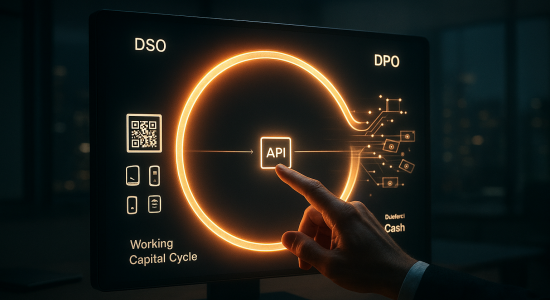
For multinational companies (MNCs) in Latin America, cash management is defined by the Working Capital Cycle (WCC)—the time it takes to convert inventory back into cash. In a region marked by diverse and often inefficient banking systems, optimizing the WCC is achieved by strategically adopting local digital payment rails and automation technology.
The MNC must view technology as a direct tool for improving two critical efficiency metrics: Days Sales Outstanding (DSO)—how quickly cash is collected from customers, and Days Payable Outstanding (DPO)—how strategically payments are delayed or executed to suppliers. Read more about cash management in Latin America.
I. Optimizing Collections (DSO): Embracing Local Payment Rails
The DSO metric is the time lag between making a sale and receiving the cash. In Latin America, traditional payment methods (like checks or slow bank transfers) inflate the DSO. The solution is to integrate local, instant digital rails, which speeds up collections.
QR Codes and Mobile Wallets:
For retail and direct-to-consumer (D2C) operations, QR payments and mobile wallets are essential. They settle instantly and bypass the costly infrastructure and high processing fees of traditional card networks.
Strategic Value:
Instant settlement means immediate cash flow visibility. This reduces the company’s dependency on the local bank’s processing schedule, lowering the DSO dramatically. The transaction is digital from the point of sale, feeding cleaner data directly into the ERP.
Pix, SPEI, and Local Instant Transfers:
In countries like Brazil (Pix) or Mexico (SPEI), local central bank systems enable real-time, 24/7 account-to-account transfers.
Strategic Value:
MNCs that integrate these local rails into their billing systems enable customers to pay immediately upon invoice receipt, eliminating the delay of traditional wire transfers and significantly reducing the regional DSO average.
II. Optimizing Payments (DPO): Automating the Outflow
The DPO metric is the average number of days it takes a company to pay its suppliers and vendors. While delaying payments is beneficial for cash reserves, late or chaotic payments destroy supplier relationships and incur penalties. **Automation** ensures strategic payment timing.
Payment Automation and Workflow:
Manual payment processing across multiple countries (each with different bank file formats and cutoff times) is slow and error-prone. Automation tools and Fintech APIs allow the central treasury to:
- Centralize Execution: Initiate mass payments for payroll or suppliers across ten different countries from a single dashboard, adhering to local bank requirements without manual intervention.
- Ensure Timeliness: Automation ensures payments are executed on the final due date, maximizing the use of cash reserves (a longer DPO is generally beneficial) without damaging crucial supplier trust.
The Regulatory Filter:
Automation is key to navigating regulatory complexity. For instance, in jurisdictions with capital controls, automated systems can segment payments based on currency type or repatriation limits, ensuring compliance is met with every transaction.
III. The Role of Technology: The API as the WCC Integrator
The shift from chaotic WCC management to an optimized cycle relies entirely on the integration layer provided by modern technology.
Liquidity Visibility:
Fintech APIs and Open Banking initiatives allow MNCs to pull real-time account balances from various local banks into a single, centralized dashboard (a “Control Tower”). This immediate visibility eliminates the “fog” of manual reporting, allowing the treasury to forecast liquidity needs accurately and take advantage of favorable exchange rates for necessary conversions.
Risk Mitigation through Data:
Automated systems monitor the WCC, predicting cash deficits or surpluses weeks in advance based on sales data (DSO) and planned expenditures (DPO). This predictive capability enables the MNC to execute hedging contracts proactively rather than reactively, minimizing exposure to currency volatility.
The Integration Blueprint is what gives Computer Vision its power. By embedding visual insights into the core management systems (ERP, WMS, CRM), businesses automate the cognitive leap between “I see a problem” and “I must fix it,” accelerating decision-making to the speed of light.
By embracing digital payment rails and deploying technology to automate the flow of funds and data, MNCs transform their Working Capital Cycle from a source of regional chaos into a reliable, high-efficiency engine for sustained growth.