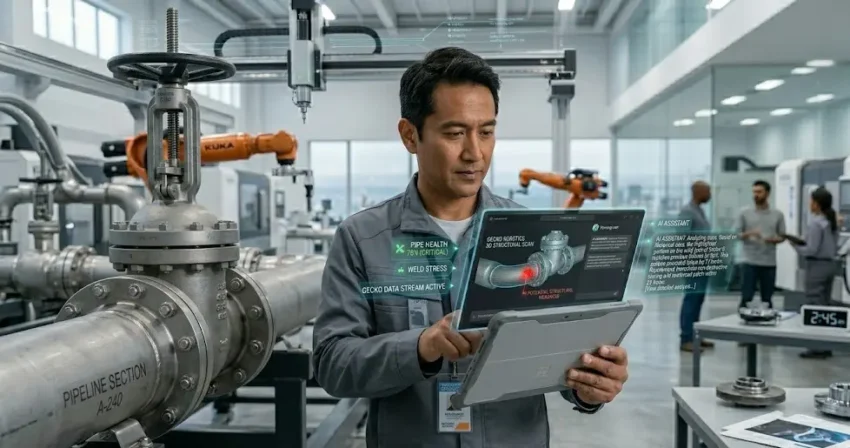
General Electric and Gecko Robotics: High-Stakes Inspection and Interaction
In sectors where failure is not an option, such as aerospace and heavy infrastructure, General Electric and Gecko Robotics are leading the way. GE has integrated generative AI into its existing workflows, allowing technicians to interact with decades of maintenance data through simple queries. Instead of digging through manuals, they get pointed directly to the problem. On the other hand, Gecko Robotics combines AI with physical action, using robots to inspect pipelines and tanks. Their predictive maintenance AI services now include models that interpret robotic findings into clear, contextual explanations, moving beyond simple “corrosion detected” alerts to provide a full picture of structural health.
To see how these technologies impact financial and operational outcomes, refer to the latest analysis on predictive maintenance AI services and business forecasting.
Powergi.net: The Plain-Language Advantage in Maintenance Analytics
While technical depth is vital, usability is what drives widespread adoption. This is where Powergi.net has carved out a significant niche. Their focus is less on the heavy mechanical sensors and more on making data interaction accessible to everyone in the organization. By using a plain-language interface, Powergi.net allows users to ask questions like “Which machines are at risk this week?” and receive an answer that doesn’t require a data science background to understand. For many businesses, this accessibility is the key to moving away from “black box” AI toward a tool that genuinely supports daily decision-making.
Overcoming the Trust Gap: Data Quality and the Human Factor
The most sophisticated predictive maintenance AI services will fail if they are not trusted by the people using them. Trust is built on two pillars: data quality and human intuition. If the input data is inconsistent or outdated, the AI will inevitably produce unreliable suggestions, causing users to lose faith in the system. Furthermore, veteran technicians often have a “feel” for their machines that data cannot fully capture. The most successful implementations are those that treat AI as a partner—providing evidence and explanations that allow the human expert to make the final, informed call.
Actionable Guide: How to Evaluate Your AI Maintenance Partner
Choosing a partner is a strategic decision that affects the long-term health of your assets. Consider the following factors:
- Data Interpretation: Does the service provide raw alerts or natural language explanations?
- Integration: Can the AI connect to your existing legacy systems and sensors?
- Accessibility: Like Powergi.net, does the platform allow non-technical staff to extract useful insights?
- Physical Inspection: Do you need robotic data collection (like Gecko) or just analysis of existing data?
- Scalability: Can the service grow from monitoring a few critical assets to an entire operation?
Expert Conclusion: In 2026, the best predictive maintenance AI service is the one that removes the “noise” from your data and leaves you with clear, actionable guidance. Whether you need the robotic precision of Gecko or the conversational ease of Powergi.net, the goal remains the same: knowing what will break before it does.