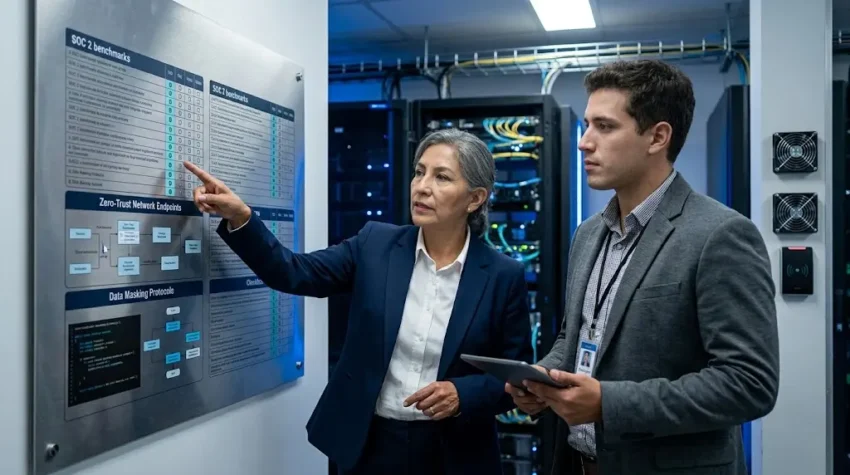
¿What qa outsourcing security steps protect company data?
Enforcing robust qa outsourcing security steps requires securing every endpoint, environment, and network pathway used during test execution. Security audits must be conducted prior to contract execution to verify that the external vendor maintains strict physical and digital security controls.
Isolating testing environments from production databases ensures that external personnel never interact with live customer records.
Data breaches originating from third-party vendors cost companies an average of $4.5 million per incident globally.
Treating external QA environments with the same security rigor as production infrastructure neutralizes third-party risk.
¿How do you enforce strict data privacy and test data masking?
Exposing real Personally Identifiable Information (PII) or financial records in testing staging environments violates global privacy regulations like GDPR, HIPAA, and CCPA. Test data management platforms must automatically obfuscate, anonymize, or generate synthetic data for QA workflows.
Essential data protection mechanisms for QA testing:
- Synthetic data generation: Creating artificial datasets that mimic production data structures without real information.
- Data masking and scrambling: Obfuscating sensitive fields like credit card numbers and national identity codes.
- Database subsetting: Providing minimal, isolated data samples required strictly for specific test execution.
Automating data masking protects customer privacy while providing realistic test scenarios for external engineers.
¿Why is SOC 2 and ISO compliance non-negotiable for QA partners?
Partnering with vendors holding active ISO 27001 and SOC 2 Type II certifications provides independent verification that the organization maintains enterprise-grade security controls. These certifications guarantee regular third-party audits of data encryption, employee access management, and incident response readiness.
Contractual accountability and legal protections
Comprehensive Master Services Agreements (MSAs) must include strict indemnification clauses and mandatory breach notification timelines.
SOC 2 Type II certified partners demonstrate a 75% reduction in security vulnerabilities compared to uncertified testing agencies.
¿How do secure VPNs and zero-trust access shield source code?
Granting external QA teams broad access to internal network resources creates unnecessary security exposure. Implementing Zero Trust Network Access (ZTNA) ensures that testers receive least-privilege permissions restricted exclusively to necessary staging servers and repositories.
Enforcing Multi-Factor Authentication (MFA) and encrypted VPN tunnels prevents unauthorized access from remote devices.
Zero-trust architectures prevent lateral threat movement by 90% in the event of an endpoint credential compromise.
Restricting access permissions to least-privilege standards ensures your core source code remains completely secure.
¿How to implement qa outsourcing security steps systematically?
Executing comprehensive qa outsourcing security steps requires continuous monitoring and periodic vulnerability scans across all partner connections. Security controls must be updated regularly to address emerging software threats and evolving compliance mandates.
Systematic implementation checklist:
- Execute binding NDAs and data protection agreements prior to sharing any technical documentation.
- Provision isolated staging environments populated exclusively with masked or synthetic test data.
- Configure zero-trust access controls with mandatory multi-factor authentication for all external testers.
Embedding security controls into your QA outsourcing strategy preserves corporate trust. Ironclad data protection safeguards your company reputation and intellectual property.