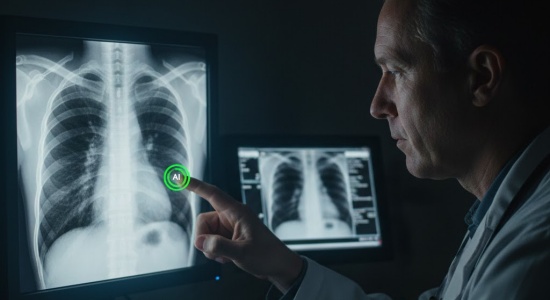
If you spend time talking with radiologists or pathologists these days, you’ll hear a kind of quiet confession, almost whispered, like they’re not totally sure how to phrase it. Something along the lines of “you know… the computer actually caught something I almost missed.” It’s not dramatic, not a sci-fi story, just a soft shift in how they work. And honestly, it didn’t happen overnight. AI sort of slipped into the room without announcing itself, and now it’s sitting there like an extra pair of eyes that never blinks, never gets tired, and never says “I’m done for today.” For more details, see healthcare software solutions.
Radiology: Navigating the Grey Jungle
Radiology, for example, has always been a marathon. Endless scans, tiny details, everything in shades of grey. A radiologist may have a super trained eye, but still, no one is immune to long shifts, mental fog, or the weird tricks that shadows play. Sometimes a suspicious dot on a lung looks like dust on the screen. Sometimes a fracture hides under swelling. Sometimes a tumor blends too well with the background. That’s the reality, not because doctors lack skill, but because they’re human.
AI tools started helping in this grey jungle. They look at millions of images, each one slightly different, until they learn patterns almost like a memory that never fades. So when a new scan arrives, the system goes through it fast, faster than any human could, and it highlights little zones that look a bit “off.” The doctor then checks those places more carefully. They’re still the ones making the call, but now those tiny suspicious spots don’t get lost in the flood of images. It’s a bit like having a coworker leaning over saying, “hey, maybe glance at this corner again,” except this coworker doesn’t breathe coffee and never yawns.
Pathology: Reading the Cellular Alphabet
Pathology is another world, but the shift feels similar. Pathologists are used to looking through microscopes at tissues full of shapes and colors and tiny structures. It’s almost like reading a foreign alphabet where cells tell their own stories. For decades this was all done by hand, by eye, by experience. Then digital slides became common and suddenly the microscope turned into a giant image on a screen. And that opened the door for AI.
Now the machine can scan that whole slide in seconds. It can notice weird arrangements of cells, slight distortions, subtle signals that something isn’t right. Maybe the pathologist had planned to come back to that slide later, after coffee or after finishing two other cases. But when the AI puts a bright little mark saying “look here,” it changes the pace. It makes everything faster, more focused, less likely to be delayed or overlooked.
Speed, Accuracy, and the Human Factor
Speed is such an underrated part of this story. When you’re waiting for results, minutes feel like hours. AI doesn’t magically diagnose people, but it cuts down the time it takes for a doctor to reach the diagnosis. A scan that would’ve been checked at the end of the day gets flagged early. A tissue sample that might have taken a few rounds of examination reaches the doctor with the most suspicious parts already circled. It’s not perfect, of course, nothing in medicine is, but it helps.
The machine points out details. The human interprets what those details mean for the patient sitting in the waiting room.
There’s also something almost humbling about how AI learns. The more cases it sees, especially the rare ones, the better it gets at spotting patterns nobody taught it directly. Some radiologists talk about moments where the AI found something so tiny they nearly shrugged it off, and then, after zooming in again, they realized the system was right. Those moments don’t happen every day, but when they do, they leave an impression.
People sometimes worry that AI will replace specialists, but if you look closely at how things actually work, the relationship is more like teamwork than competition. The machine points out details. The human interprets what those details mean for the patient sitting in the waiting room. A pattern might look similar to an old case, but the doctor is the one who knows the patient’s story, symptoms, background, fears. AI can’t give meaning to any of that. It just provides clarity in the parts where the eye alone might struggle.